
The World’s 25 Largest Coffee-Producing Countries: Vietnam Ranks Second
In the 2025/2026 crop year, Brazil continues to lead the world with 63 million bags of coffee, while Vietnam ranks second with 31.7 million bags, accounting for 18% of global production.
Coffee is an essential part of the morning routine for millions of people and one of the world’s most widely traded agricultural commodities. Production is concentrated in a relatively small group of countries, most of which are located within the “Coffee Belt” between the Tropic of Cancer and the Tropic of Capricorn.
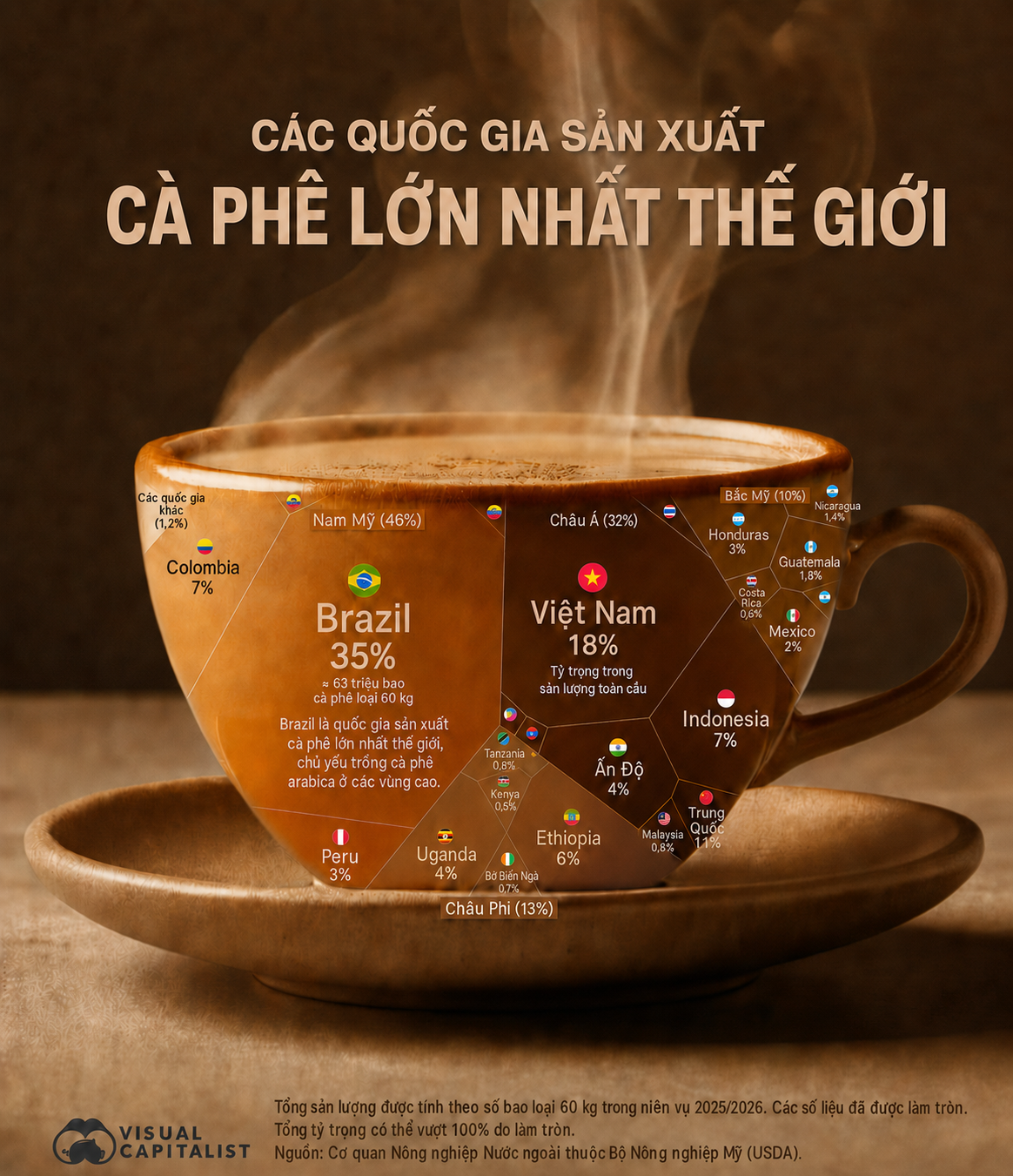
Using data from the U.S. Department of Agriculture’s Foreign Agricultural Service (USDA FAS), the infographic below ranks the world’s largest coffee-producing countries in the 2025/2026 crop year based on their shares of total global green coffee production.
BRAZIL AND VIETNAM DOMINATE GLOBAL COFFEE PRODUCTION
In the 2025/2026 crop year, Brazil produces 63 million 60-kilogram bags of green coffee, equivalent to 35% of global output. Most of Brazil’s production consists of Arabica coffee, a variety commonly grown at higher elevations and widely used in the specialty coffee segment as well as in premium products.
Brazil’s output alone exceeds the combined production of Vietnam, Colombia, and Indonesia. Together, those three countries produce 56.6 million bags.
Vietnam ranks second globally with 31.7 million bags, representing 18% of worldwide coffee production. This is roughly half of Brazil’s output but nearly three times that of Colombia.
In addition to being one of the world’s leading coffee production hubs, Vietnam is also known for distinctive beverages such as egg coffee and salted coffee.
Although coffee has been cultivated in Vietnam since the mid-19th century, the country’s prominent position in the global market was only firmly established in recent decades. In 1999, Vietnam surpassed Colombia to become the world’s second-largest coffee-producing country.
This growth has been driven primarily by the rapid expansion of Robusta cultivation. Robusta is a hardier coffee variety with a higher caffeine content and is commonly used in instant coffee, espresso blends, and lower-cost commercial coffee products.
Vietnam’s production exceeds that of third-ranked Colombia by 19.2 million bags. Colombia produces 12.5 million bags, accounting for 7% of global output.
Indonesia follows closely with 12.4 million bags. Ethiopia, widely regarded as the birthplace of Arabica coffee, ranks fifth with 11.6 million bags, equivalent to 6% of worldwide production.
ASIA IS PLAYING AN INCREASINGLY IMPORTANT ROLE
South America remains at the heart of the global coffee supply, with Brazil, Colombia, and Peru among the region’s major producers. However, its share of world production has declined compared with the 1960s as coffee output in Asia has expanded rapidly.
Asia’s share of global coffee production has risen from less than 5% in the 1960s to 32% today. The primary driver of this increase has been the substantial expansion of Robusta cultivation in Vietnam.
In addition to Vietnam, other Asian countries including Indonesia, India, China, Malaysia, Thailand, Laos, and the Philippines also contribute to the region’s coffee output.
Although coffee originated in Africa, the continent currently ranks third among the world’s coffee-producing regions. Production is concentrated mainly in Ethiopia, Uganda, Tanzania, Côte d’Ivoire, Kenya, and Rwanda.
Looking ahead, climate change is expected to create additional challenges for the coffee industry by reducing bean quality, shrinking the amount of land suitable for cultivation, and increasing the risk of pests and diseases.
Notably, the global coffee supply remains highly dependent on a relatively small number of producing countries. As a result, adverse weather events in major coffee-growing nations can cause significant fluctuations in output, potentially placing further upward pressure on coffee prices, which are already at elevated levels.
Source: https://vneconomy.vn/25-quoc-gia-san-xuat-ca-phe-lon-nhat-the-gioi-viet-nam-xep-thu-hai.htm